Tuesday, 3 July 2012

Back to the Bijou Residence once more.

 On the day following Spain’s footballing victory I came across this cartoon in a Pontevedra newspaper. The Roman chappy is doing that “I came, I saw, I ...” thing when a Spaniard taps him on the shoulder and interrupts his train of thought. “Now,” says the Roman chappy, “what was the third one?” A little mean, but quite good fun. 
 We have stayed a couple of nights with our friend Colin in Poio, rather envying the view from his window overlooking Pontevedra. There was quite a houseful with us, another friend of Colin’s from the North West of England and a couple of globe-trotting Australians who have been house-sitting for Colin while he was home in the UK for a while.

We all went down into town (i.e. Pontevedra, where the sun was still shining) last night to sample an excellent selection of mostly seafood tapas: squid, prawns in garlic, zamburiñas – some kind of scallops – as well as tortilla, croquetas and pimientos de Padrón. All very good, especially with a nice bottle (or two) of chilled white wine to wash it down. 

Just next to the restaurant where we ate was a place called “Dr Livingstone, Supongo”, decorated to look as though the famous explorer could walk in at any time. Despite a huge model rhinoceros and some belief that it is in the style of an English pub, it still manages to look very Spanish. 

Today we said farewell to Colin with yet another excursion to a seafood place for lunch. In fact, over the last ten days we seem to have consumed a huge amount of food. Ah well, we can start to cut down ... tomorrow, though, after we have visited the Nuevo Derby this evening, down in Vigo centre, to use their Wifi and get some free snacks . 

Back in the bijou residence, it’s a good job I managed to work out how to make the washing machine complete its spin cycle, as there is a mountain of washing to get through. 

The sun has obviously shone in Vigo as well during our absence, so I was pleased to discover that Rosemary and Basil, the herbs who live on the kitchen window ledge, have not only survived but thrived while we were away. I left them in a plastic box full of water but I was unsure how well they would get along, as we were leaving them for about ten days. But there they are, bright and perky. 


 To think that I was once told that basil cannot be grown in Vigo as it’s too far north!!!!(Honest!)

Monday, 2 July 2012

Adiós, Sanxenxo! Hasta el año próximo.

On Saturday, picking up chocolate in the supermarket (the chess player takes a little in his pencil case so that he can have an energy boost if necessary) I found myself stuck behind an elderly lady at the checkout. This very smartly dressed old dear had bought a couple of things coming to a total of €8.26 and proceeded to hand over a €500 note. As the till rang up “Cambio €491.74, the cashier didn’t blink an eyelid but did say quietly to her colleague, “¡Mírame esto! (Take a look at this!)” In the end, the old dear had to wait for her change but the cashier managed to serve me in the meantime. I made sure that I paid over the exact small amount of money I owed them. 

I had been given to understand that most €500 notes are passed around by drug barons. If that is the case, drug barons in Galicia look like respectable (but rich) little old ladies. Maybe she is the mother or grandmother or maiden aunt of drug barons and doesn’t know where the money comes from. Whatever the truth, of the matter, it was quite something to see such a large denomination note in a small Froiz supermarket. 

The chocolate seems to have worked its magic, aided by the cups of coffee delivered by this blogger, for the chess player managed to win the veteran’s prize for the third year running. The prize money will only go a very small way towards paying the hotel bill but it’s the pride thing that counts. We have standards to maintain, after all. 
 
While the chess player was slaving away over the chessboard, I was taking a last stroll around Sanxenxo. The Madama de Silgar was busy showing her solidarity with the Spanish football team, playing against Italy in the final of the European Championship this evening. I wonder who went out into the water to give her the flags to wave. The beach was once more full of sunbathers and the inevitable walkers-up-and-down-the-tide-line. 
 
In the more shady streets behind the church a little craft market had been set up with leather goods and hand-woven baskets on sale, no doubt for silly prices. You could buy huge loaves of dense wholemeal bread, good for you but heavy going in my experience, but you could wash it down with cups of some local brew at the stall next door. And, of course, there were huge empanadas - Galician Pie as it was translated for me by a waiter in our hotel - a regional delicacy which I feel is somewhat over-rated, the consistency of the pastry casing being generally reminiscent of cardboard, in our experience. 
 
All of this was accompanied by the inevitable gaita band, in this case a rather scruffy one. They had clearly not dressed up for the occasion. 

At one stall, a much more traditionally, but quite conservatively, dressed artisan was making bead trimming, a task that requires considerable patience. Like lace-making, it is done across a cushion with a paper pattern for the craftsman to follow. He told us that the one he was working on is just one of hundreds of traditional patterns. Many more have been lost, he lamented, because when old Gallego traditional outfits were rescued from old store rooms and chests, while it was possible to restore much of the fabric, the beadwork had faded or broken off or was simply carelessly thrown away. There still seem to be plenty of patterns left, however, and there is a demand for them; he told us that he had been commissioned to make about 36 metres of it. 

Anyway, having mooched around the delights of Sanxenxo for one last time, I got back to the hotel in time to see the end of the chess tournament. The chess player was presented with his prize at the closing ceremony, we said goodbye to our chess friends and set off for the bus station. 

Now we are in Pontevedra now for a couple of days! We watched the big match last night. It was hard to know which team to support. I have friends who support both teams. But in the end Spain pulled off the victory: 4-o!! Fireworks on all the hillsides around here. So that’s the football over for the time being. 

 Ah well, never mind. The Tour de France has just begun and I can now give my attention to the progress of one Bradley Wiggins from the Isle of Man, tipped as the first likely British winner of the Tour. We shall see.

Saturday, 30 June 2012

Success - we hope!

I closed yesterday saying that I had a cena to get ready for. I then looked at the time and realised that it was after 9 o’clock and the chess player had not surfaced. So I went looking for him, expecting to find him deep in analysis of a game. No such thing; he was still playing, surrounded by a host of spectators as this, the last game to finish, was coming to a nail-biting close. Just before 9.30 he finally managed to win it, much to everyone’s relief as the cena was due to start at 10. Just time to shower and go and eat. 
 
And very good eating it was too with lots of interesting shellfish and huge paella pans full of arroz con bogavante. Delicious! Many toasts were drunk in good, cold albariño wine. A good time was had by all. It was an international occasion: Spanish, of course, English (us), a family of Swedes (who were quite intrigued to discover how much Swedish TV we have been watching lately – we tried to find an occasion to thank them so that we could say “tag” but it never happened), some Portuguese and some South Americans. We even had a birthday in our group, so we had a cake and a song as well. 
 
 Now, we had agreed that if Phil lost his game yesterday he would take a day off today and go with me to the Isla de Ons, an island cum nature reserve which he managed not to visit last time we were here. However, having won, he stayed in the hotel to play chess. There may be a prize at the end of this if all continues to go well. 
 
So I went off to the island on my own. It’s not quite so spectacular as the Islas Cíes, just outside Vigo bay, but is certainly worth a visit. You are not allowed to pick flowers or collect shells. However, there is nothing to stop you taking photos of all these things. Nothing must upset the ecological balance of the island and therefore you must take nothing away and leave nothing behind. Looking at my sandy feet before I caught the boat back, I wondered if the ecology police would make us all wash the sand off before we boarded the boat. 
 
 On the way out I had seen canoeists just outside Portonovo but on the way back it was much more spectacular. 

The Liga Galega de Traineras had organised a boat race for this afternoon and teams of rowers were working away to complete the circuit of the bay in the fastest time possible. 
 
Rowing in the sea like this makes the Oxford and Cambridge boat race seem very sedate. I’m sure the Oxbridge rowers will not agree with me but they don’t have waves to contend with as far as I know. 

So it was back to the hotel to give the chess player some support. I have been taking him coffee half way through his games to give him an energy boost. This seems to be working. Before he had the coffee today he felt he might be losing. After the coffee, he won in just a few minutes. The caffeine is working its magic apparently. 

And so our week at Sanxenxo comes to an end. Last round tomorrow morning and we shall see whether a prize goes with us to Pontevedra, our next port of call.

Friday, 29 June 2012

Spanish Practices.

Well, the intrepid explorers made it to Portonovo and just a little beyond this morning, without mishap and without climbing over or sliding down any rocky places. Quite a relief really! We gave up walking much further than the Playa de Caneliñas because in the end one pretty bay is much like another and besides we wanted to be back in time for lunch. The water was a very nice shade of turquoise though. 
 
Just above the Playa de Caneliñas was this statue of a working woman, carrying a tray of something on her head. Whether it was meant to be fish or bread or some other kind of merchandise I have no idea. There was no explanation. She is certainly striding out very purposefully and I do know that until not too long ago it was fairly standard for the women of this area to carry stuff around on their heads. 

On the way back I spotted this sign announcing ice for sale. Now, this is not an old, decrepit sign. It looks fairly recent and it’s not the first I’ve seen this summer. Do people still buy ice in this age of electronic devices in every kitchen? Perhaps they do. After all many people still have gas delivered to their houses in great orange canisters, as this lorry full of such canisters shows. 
 
I include this photo as well for my friend Colin who likes to point out the odd parking habits of the Spanish. The lorry on the corner spot is yet another example. These are just things that you don’t usually get to see in the UK. 

I also saw a cafe with a notice stating: "Prohibida la entrada sin camiseta" - No entry without your T-shirt.  This reminded me of all the men sitting outside pubs in the Uk or in pub gardens with their T-shirts off and their tattoos on show. Not acceptable behaviour here in Spain.

Every so often you get reminders of just how foreign Spain still is. This afternoon I went to buy aspirin. What I hadn’t noticed was the sign outside the shop was for a “Parafarmacia” and not a “Farmacia”. The “parafarmacia” can’t sell you medicines, not even aspirin or paracetamol. I find this strange in a country where everyone’s mother knows a remedy for just about every ailment going. And so I had to hunt around until I found a “proper” chemist. Goodness knows how the Spanish react when they go to England and find you can buy painkillers in the supermarket or even in the corner shop. 

I am reading more Isabel Allende, this time one of her long novels, “Hija de la Fortuna”. At one point one of her characters, Tao Chi’en, a Chinese medicine man (for want of a better way to describe him), is in San Francisco in the 1850s, at the time of the gold rush. He comments on the immigrant population: “Allí nadie era lo que parecía, el estibador del muelle podía ser un aristócrata latinoamericano y el cochero un abogado de Nueva York”. Roughly translated: “There no-one was what they seemed, the stevedore at the quayside could be a Latin American aristocrat and the coachman a New York lawyer”. So the situation of immigrant workers hasn’t really changed much! 

Tonight we have a “cena especial”, a special dinner for the chess players. I will report on what wonderful food they give us. Then at the weekend we get to watch Italy and Spain hammer it out in the final of the European Cup. Spain had better win; after all Rafa Nadal has just been knocked out Wimbledon! Who would have expected that at this early stage? We watched Italy make fairly short work of the Germans last night. The Germans fought hard but didn’t make it. I almost feel better about the English team losing to Italy on penalties now. At least we didn’t actually concede any goals UNTIL the penalties. 

On the subject of penalties, I am going to have to ask someone to add the word to the Spanish dictionaries with an accent on the E so that the Spanish commentators, professional and in the bar, can stop mispronouncing “pEnalties” as “penAlties”. Normal Spanish rules of pronunciation put the emphasis on that next to the last syllable but its beginning to annoy me. I know the English have no room to talk. It annoys me just as much when I hear an English person say “no problemo” or pronounce “machismo” (ch as in church) as if it were an Italian word “maKismo”. And then there's Picasso's painting Guernika which the English often pronounce with the emphasis on the first syllable!

That’s it. Rant over. Time to go and get dressed up for the “cena especial”.

Thursday, 28 June 2012

Trespassing??

Today the intrepid explorers set out to investigate the promontory just at the end of the Paseo Marítimo, the headland that divides Sanxenxo proper from Portonovo. Mostly it’s a very civilised little park area, with a playground for children and absolutely masses of hydrangea bushes. This part of Spain could be the world hydrangea capital; there are so many beautiful specimens in a whole range of colours. 

So we walked along the path past the oh-so-beautiful hydrangeas, under the trees and up to a point where we had to decide between following the path round and then taking the road and the boardwalk to Portonovo or scaling the rocks around the rest of the headland and getting through that way. 

As the tide was part way out we opted for the latter course. All went well, even if it was a little steep for me as my legs are shorter than the other intrepid explorer’s. It looked as if we were going to get through to Portonovo without problem. 

And then we reached a place where it was clear that the way down had suffered from erosion and slippage, leaving a rather too steep descent into Portonovo bay. What’s more we appeared to be in somebody’s garden. Keeping to the edge of the garden as much as possible, we made our way past the empty – well, apart from a collection of dead leaves at the bottom – swimming pool and round to the front of the house. At the end of the drive was an impressive, and locked, gate. So we circled back round the house, looking for the front door. All the shutters on that side of the house were down. No-one there. It is probably somebody’s summer residence and a very nice one too, I must say. Maybe they’ve not started their holidays yet. That would explain the waterless, leaf-filled swimming pool. 

We still had to find a way out, however. We never like to go back the way we’ve come. Far too sedate an option. And besides, the rather steep climbing places (for the shorter-legged intrepid explorer) would be even harder to descend. Eventually we found a break in a fence where you could sit at the top and kind of launch yourself into the not too huge drop down to the next level. This we did and prepared to continue on our walk. 

It was then that I noticed that my intrepid explorer companion must have caught his shorts on something sharp and now had a neat L-shaped tear in them. Some adjustment of dress was necessary to ensure decency was maintained and we made our way back to the hotel by the shortest route possible. 

 There this intrepid explorer had to turn herself into a seamstress and do some running repairs. It’s a good job I am a blogger of many skills. It’s a good job I bought a sewing kit from the Chinese bazaar across the road as well!!

Wednesday, 27 June 2012

Of Patos and Pazos

Normally in the morning I leave the hotel, go down to the Paseo Marítimo and turn left to run to the lighthouse and back. How much we humans are creatures of habit. This is day 4 of our stay in Sanxenxo (5 if you count Saturday when we arrived half way through) and I have a routine established and can talk about what I “normally” do. Be that as it may, this morning I went down to the Paseo Marítimo and turned right to run to Portonovo, the bit of Sanxenxo round the corner and over a bit of a hill and where they have a nice beach of their own. The “over a bit of a hill” part is reasonable hard going but then you get to run on the boardwalk and on the beach instead of along a paved walk. 

On the beach I was accosted by a chap who asked me, “¿Miraste a pata y os patitos? Están allí.” You don’t expect people top start asking you about ducks and ducklings when you go for a run, especially in a mix of Castilian and Gallego. But indeed Mr Duck and ten by now fairly large duckling (teenage ducklings?) were paddling and then swimming in the sea. I’ve never seen ducks in the sea before but I suppose that if they nest on the coast – two ladies told me that they nest in the dunes and waddle down to the sea every morning – then the sea is the logical place to take the youngsters for a swim. 

Later Phil and I set out to walk the “ruta urbana” that the young lady at the tourist office had pointed out to us yesterday. 

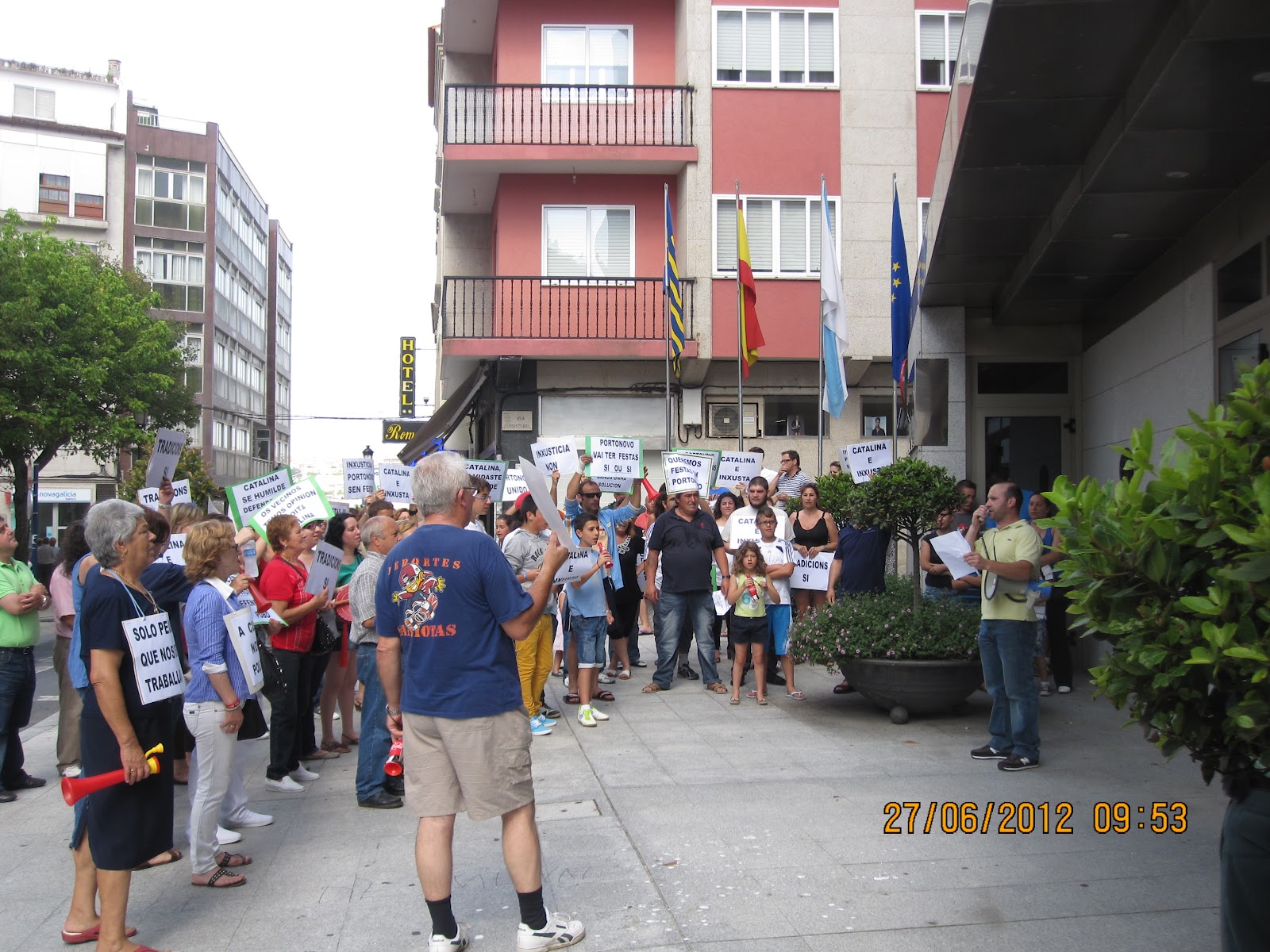
As we set out from the hotel we could hear a lot of whistle blowing and hooting of horns. A demonstration? Well, there was little sign of one but then I noticed a bunch of people kind of straggling along the Paseo with placards of sorts. When they stopped for a bit of a shout down by the town hall you could see that these were the people of Portonovo, protesting about “inxusticia” and demanding the right to some autonomy. “¡Queremos festas de Portonovo! Let them have their fiestas, say I. 

The “ruta urbana” is supposed to take you past several Sanxenxo “pazos”, Gallego for “palacios”, stately homes rather than palaces. I seem to remember we tried this unsuccessfully last year and didn’t find any “pazos” except the very first one: the Pazo Emilia Pardo Bazán. This is in fact a conference centre which has been named for this woman writer who has been described as one of the most remarkable Spanish intellectuals of the 19th century. The mad lady who recently wanted to sign me up for a series of packs of information about Galicia and its culture told me that Emilia Pardo Bazán was famous as a writer of cookery books. When I told her she had written poetry and essays among other things she told me once again, “Pero escribió libros de cocina”. Emilia Pardo Bazán wrote precisely TWO cookery books and a whole pile of other stuff. 
 
Anyway, she was born in La Coruña and is a famous Galician woman, en example to feminists every where, I expect. Here is a link to some information about her. Today, we once more found the Pazo Emilia Pardo Bazán and to prove it I had my photo taken next to a statue of a rather dumpy Victorian-looking lady.

Moving on up the hill we had some difficulty locating the Pazo de la Torre de Miraflores. Phil set off up a track which looked promising but only led to a vineyard. 

So we retraced our tracks since the road appeared to be leading us way out of town. And we almost missed it again but at the last moment I spotted some once grand but now rather neglected looking gates. Behind the gates was an equally neglected looking building which, since it had a tower of sorts. we assumed to be the Pazo de la Torre de Miraflores. 

Next on our list was the Pazo do Virrey de Padriñán. Once more it was a case “blink and you’ll miss it”. But we found it, intrepid explorers that we are. Someone needs to do a bit of signposting of these bits of heritage, especially if the tourist office is going to give out maps with routes and bits of information about them. 

On the way back, it tried to rain on us but not really serious rain, just a summer shower. So, were we downhearted? Not one bit! A successful bit of tourism completed!

Tuesday, 26 June 2012

Sights of Sanxenxo

At nine o’ clock this morning, as I jogged down the promenade, I spotted a man doing yoga on the beach. He seemed to have gone beyond the Saludo al sol (and the sun was up and bright ready to greet him back) and had progressed to a little meditation. Either that or he was into a cult of adoration of La Madama de Silgar, the statue out on the bay. 

On my way back I had to duck and weave around enormous numbers of old ladies and gents who had been disgorged from a bus on the corner of the street just below our hotel. Pensioners outings to Sanxenxo, obviously! 

A more usual sight than the yoga man is that of the ladies on their way to the beach, this one captured later in the morning. The style of the big yellow coverall is very common among ladies of a certain age and size, even though it looks a little as though they have come out in their nightdresses. But it’s a very sensible way of covering your swimsuit and possibly more dignified than the short version favoured by her companion. 

 We saw the same yellow coverall and striped sunhat make their way into the dining room at the hotel at lunchtime. Tables full of elderly ladies and gents tucking in and, being Spanish, talking nineteen to the dozen. Somebody once told me that the English often consider the Spanish rude as they always seem to interrupt you. It was then explained that we English have the habit of stopping at the end of one statement and taking a breath before starting the next, pausing just slightly but sufficiently long to make a Spaniard think you’ve finished. They then leap in with the next thing they want to say as soon as possible before someone else does so. If this is the case then our friend Colin’s mate Mike could possibly be a Spaniard as both Colin and I had difficulty getting our comments in last time we met for lunch. 

On the subject of lunch, it has to be said that the food here at the Hotel Carlos I Silgar in Sanxenxo is very good, quite imaginative, very nicely presented and, above all, served in copious amounts. For lunch today we started with “crepes de mariscos”, shellfish nicely parcelled up in a pancake: very tasty. We went on to “chipirrones”, baby squid prettily arranged around the ubiquitous Galician potatoes: also very tasty. There was a third course: “churrascos”. We cause some concern to the restaurant staff here as we never want three courses. After the first two today there was no way that ribs, cauliflower and a mountain of chips were making their way into my stomach. I wasn’t struck on the desert either, another custard/cream/patisserie affair, so we had yoghurt instead. Don’t get me wrong; I am not criticising the service; I think it’s excellent just a little too much for my taste. If you stay here with full board and really do justice to the meals they offer, you must leave several stones heavier at the end of a week. Maybe it’s to encourage people to stay on a bit longer and have “treatment” in the spa, working off the extra kilos. 

In the lift I saw this notice for one of the “tratamientos” available. For a mere €52 you can have an apple hydromassage, a facial with apple stem cells (I believe that’s what “células madre” are) a fancy, revitalising foot massage and various other things. Now, I know that an apple a day is supposed to keep the doctor away but, really, this is a bit over the top. Does the facial consist of them covering your face with apple purée or what? €52 is a bit too much for me to spend to find out. I guess I’ll just stick to my morning jog down the prom and regular dips in the pool. 

Today I swam this morning, around midday in fact but before the sun was at its highest, instead of later in the day. This does not exclude my going back for more at about seven o’clock, however. At the moment it is so hot out there that you would have to be in the pool to feel comfortable at all. Inside the hotel, though, we have the air conditioning on so it’s not a problem. Oh, yes, I do know it’s not good environmentally but, boy, does it feel good?! 

Anyway, the pool at the end of the morning was much better than at around five in the afternoon. Quite simply, there are fewer little boys leaping into the air, hugging their knees to their chest and shouting “¡¡¡BOMBA!!!!” as they splash bottom first into the water. I have nothing against children in the pool so long as they don’t disturb my gentle plod up and down.

This morning it was me and about five other sensible adults: perfection!